|
The Epic Musical of the Classic Novel Don Quixote!
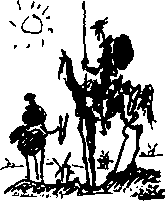
Man of La ManchaWritten by Dale Wasserman
Music by Mitch Leigh Directed by David Clevinger Musical Direction by Timothy D. Turner Lighting Design by William Dumas Stage Management by Produced by The Bay Street Players of Eustis, Florida Auditions in May, Information below! Principals (1 Woman; 1 Man) Supporting (1 Women; 4 Man) Cameo (3 Women; 11 Man) and Ensemble Performances on July 20, 21, 26, 27, 28 & Aug 2, 3, 4, 9, 10, 11 @ 8 p.m. // July 22, 29& Aug. 5, 12 @ 2:30 p.m. at Historic State Theatre in downtown Eustis at 109 North Bay Street (click for map) Man of La Mancha is a 1965 Broadway musical in one act, which tells the story of the classic novel Don Quixote as a play within a play, performed by Miguel de Cervantes and his fellow prisoners as he awaits a hearing with the Spanish Inquisition. It is performed on a single set, arranged to vaguely suggest a dungeon. All changes in location are suggested by alterations in the lighting and by the creative use of props supposedly lying around the floor of the dungeon; there are no detailed stage sets. This was done to encourage the participation of the audience's imagination in the enjoyment of the show. (More recent productions, however, have added more scenery.) The book was by Dale Wasserman, lyrics by Joe Darion, and music by Mitch Leigh: one song, "The Impossible Dream," was particularly popular. "Man of La Mancha" started its life as a non-musical teleplay written by Dale Wasserman for CBS's Dupont Show of the Month program. This original staging starred Lee J. Cobb, probably best known for his portrayal of Willy Loman in Arthur Miller's Death of a Salesman. The Dupont Corporation disliked the title Man of La Mancha because its viewing audience would not know what La Mancha actually is, either on a geographical or symbolic nature, so a new title, I, Don Quixote, was chosen. Upon its telecast, the play won much critical acclaim. Years after this television broadcast, and after the original teleplay had been unsuccessfully optioned as a non-musical Broadway play, director Albert Marre called Wasserman and suggested that he turn his play into a musical. Mitch Leigh was selected as composer. The original lyricist of the musical was world-renowned poet W. H. Auden, but his lyrics were discarded, some of them overtly satiric and biting, attacking the bourgeois audience at times. The musical first opened at the Goodspeed Opera House in Connecticut in 1964. Rex Harrison was to be the original star of this production, but soon lost interest when he discovered the songs must actually be sung. Michael Redgrave was also considered for the role. Richard Kiley won a Tony Award for his performance as Cervantes/Quixote on Broadway in the original production, and it made Kiley a bona fide Broadway star, but the role went to Peter O'Toole in the less-successful 1972 film. O'Toole, however, did not really sing his own songs; they were dubbed by tenor Simon Gilbert. All other actors in the film, however, from non-singers such as Sophia Loren to Broadway musical stars such as Julie Gregg, did do their own singing. The only member of the original cast to reprise his role in the film was Gino Conforti, repeating his hilarious turn as the amazed barber, whose shaving basin is mistaken by Don Quixote for the Golden Helmet of Mambrino. Although the bulk of the film was made on two enormous sound stages, the use of actual scenery was much more explicit - Don Quixote is shown fighting a real windmill, while onstage this had been merely suggested by having Quixote run offstage to agitated music, and then crawl back onstage a few seconds later, with his lance broken and his sword twisted. The play ran on Broadway five times: 1965 - 1971 original production, opened November 22, 1965 with Richard Kiley as Miguel de Cervantes and Don Quixote and ran for 2,328 performances . John Cullum and José Ferrer also played the roles during this run. 1972 - revival, Richard Kiley as Cervantes and Quixote. 1977 - revival, Richard Kiley as Cervantes and Quixote. 1992 - revival, Raúl Juliá as Cervantes and Quixote, Sheena Easton as Dulcinea. 2002 - revival, Brian Stokes Mitchell as Cervantes and Quixote, Mary Elizabeth Mastrantonio as Dulcinea, Ernie Sabella as Sancho Panza. AWARDS 5 Tony Awards for Musical, Composer and Lyricist, Director, Scenic Designer and Actor The New York Drama Critics Circle Award for Best Musical The Outer Critics Circle Award for Production CastDon Quixote(Cervantes) played by Ken Rush
Aldonza (Dulcina) played by Kelly Elisabeth Fagan Sancho Panza played by Steven Merens Antonia played by Jennifer Bonner Dr. Corrasco / Duke played by Jeff L. Lingberg Innkeeper played by Kent Walker Padre played by Jonathan Olson Anselmo played by Rick Breese Barber played by Ashley Richards Captain of the Inquisition played by Henri “Hank” DeLorme Govenor played by Todd Lutz Housekeeper played by Heather Good Jose played by Don Schoonover Juan played by David Bray Maria played by Noel Miner Paco played by Ashley Richards Pedro played by Al Brosman Tenorio played by Derek Smith Manuel played by Todd Lutz Horse played by Sarah Redmond Mule played by Matthew Kinnison Knights played by Al Brosman, David Bray, Rick Breese, Matthew Kinnison Prisoners played by Irene DeLorme, Jeff Friberg, Rebecca Lewis, Natalie Renick, Colby Lutz, Daun Lutz, Susan Trewyn Musical Director BiographyTimothy D. Turner has been performing professionally for 27 years in professional & commercial productions, on stage and screen, with celebrities such as Rita Moreno & Marvin Hamlisch and groups like Canadian Brass & the King’s Singers. He has directed and produced theatre, cabarets, stage shows, concerts and film for more than 20 years throughout the continental United States and Europe. This is his 6th production with The Bay Street Players, and marks his 80th production in the area since his relocation to Central Florida in 2001. He holds a BM in Performance from Millikin University and works as a director, performer, performance coach, clinician, producer, composer, community organizer and writer. Currently, he resides in Longwood, Florida just north of Orlando, but he travels extensively as a working professional.
Presented in Special Arrangements with

Synopsis Miguel de Cervantes, aging and an utter failure in his varied careers as playwright, poet and tax collector for the government, has been thrown into a dungeon in Seville to await trial by the Inquisition for an offense against the Church. There he is hailed before a kangaroo court of his fellow prisoners; thieves, cutthroats and trollops who propose to confiscate his meagre possessions one of which is the uncompleted manuscript of a novel called "Don Quixote." Cervantes, seeking to save it, proposes to offer a novel defense in the form of entertainment. The "court" accedes and before their eyes, donning makeup and costume, Cervantes and his faithful manservant transform themselves into Don Quixote and Sancho Panza. They proceed to play out the story with the participation of the prisoners as other characters.
Quixote and Sancho take to the road, on "horses" which dance a lively flamenco, singing Man of La Mancha in a campaign to restore the age of chivalry, to battle evil and right all wrongs. The famous encounter with the windmills follows, but Quixote ascribes his defeat to the machinations of his enemy, the dark Enchanter, whom one day he will meet in mortal combat. In a roadside inn-which Quixote, spying from a distance, insists to Sancho is really a castle-Aldonza, the inn's serving girl and part-time trollop, is propositioned by a gang of rough Muleteers. Quixote, arriving at the inn, sees Aldonza as the dream-ideal whom he will serve evermore, singing Dulcinea to her. Aldonza is confused and angered by Quixote's refusal to see her as she really is. The Padre and Dr. Carrasco arrive at the inn but on questioning Quixote, are frustrated by his lunatic logic. They are interrupted by the arrival of an itinerant Barber singing The Barber's Song. Quixote confiscates the Barber's shaving basin, convinced that it is really the "Golden Helmet" of Mambrino, and is ceremoniously crowned with the aid of the Muleteers and the incredulous Barber. Later Aldonza encounters Quixote in the courtyard where he is holding vigil, in preparation for being dubbed a knight by the Innkeeper. She questions him on his seemingly irrational ways, and is answered by Quixote in a statement of his credo, The Impossible Dream. Aldonza has caught the fever of Quixote's idealism but, attempting to put it into practice, is cruelly beaten and ravaged by the Muleteers in The Abduction and is carried off. On the road again, Quixote and Sancho encounter a thievish band of Moors and are robbed of all their possessions in the The Moorish Dance. They return to the inn, only to encounter the disillusioned Aldonza who sings her denunciation of the Quixotic dream in the dramatic Aldonza. A fantastic figure, the Enchanter disguised as the Knight of the Mirrors, enters; challenging Quixote to combat, the Enchanter defeats him, forcing him to see himself as a pathetic clown. At home again, the old man who once called himself Don Quixote is dying. Aldonza, having followed, forces her way into the room, pleading poignantly with him to restore the vision of glory she held so briefly, in the song Dulcinea. Quixote, remembering, rises from his bed to reaffirm the stirring Man of La Mancha, but collapses, dying. Aldonza, having glimpsed the vision once more, refuses to acknowledge death, saying, "My name is Dulcinea." Back in Cervantes' dungeon the prisoners, dregs of humanity though they are, have been deeply affected by his story and restore to him his precious manuscript. Cervantes is summoned to his real trial by the Inquisition. The prisoners unite to sing him on his way with The Impossible Dream. Production Company Information
CLICK HERE for information page
|
Audition InformationPlease prepare a musical selection, preferably not from Man of La Mancha—please bring sheet music in your key. An accompanist will be provided. CD accompaniment discouraged as this will be a live musical production. There will also be cold readings from the script. For additional information, please call (352) 357-7777(352) 357-7777.
A note for young people auditioning… Speak clearly and respond to questions asked by the audition team, and to listen carefully and follow directions. Have fun and try to relax, only then will you do your best! Display confidence. Speak and sing clearly and try to keep a clear focus when singing. May 21, 2007 7:30 - 10 p.m. Open Auditions May 22, 2007 7:30 - 10 p.m. Open Auditions All Auditions, Workshops, Rehearsals & Performances at The Historic State Theatre in downtown Eustis, FL (click for map) Bay Street Players information (352) 357-7777(352) 357-7777 Character Role Age Sex Voice Range Dancing Aldonza (Dulcina) — A wild, lusty, middle-aged woman whom Don Quixote takes a fancy in. Lead 35 – 55 F Soprano (A♭3 to A♭5) Light Don Quixote(Cervantes) — Plays both a tax collector and a knight. He is enthusiastic and optimistic. Lead 30 – 60 M Baritone (B2 to E4) N/A Antonia — Alonso Quijana's self-centered niece who is about to be married to Dr. Carrasco Supporting 18 – 32 F Mezzo (C4 to F5) N/A Dr. Corrasco — Loves money. Supporting 35 – 55 M Baritone (C3 to D♭4) N/A Innkeeper — A strong but kind and sympathetic man. Supporting 35 – 65 M Bass (G2 to D♭4) N/A Padre Supporting 40 – 60 M Tenor (F3 to G4) N/A Sancho Panza — Don Quixote's pragmatic, loveable and loyal servant. Supporting 30 – 50 M Tenor (C3 to G4) N/A Anselmo — A rough, sturdy muleteer. Cameo 22 – 35 M Tenor (A3 to G♭4) N/A Barber — *A comic part. Cameo 30 – 65 M Tenor (D3 to G4) N/A Captain of the Inquisition — An imposing, cruel man. Cameo 30 – 55 M N/A N/A Contour Cameo 21 – 65 M Tenor (F3 to A♭4) N/A Fermina — A serving girl. Cameo 16 – 32 F N/A N/A Housekeeper — Alonso Quijana's strong housekeeper who is full of hope. Cameo 30 – 70 F Mezzo (F3 to F5) N/A Jose — A Muleteer Cameo 20 – 40 M N/A N/A Juan — A Muleteer Cameo 20 – 40 M N/A N/A Maria — The innkeeper's shrewish wife. Cameo 35 – 60 F N/A N/A Paco — A Muleteer Cameo 20 – 40 M N/A N/A Pedro — A rough, sturdy muleteer. Cameo 22 – 35 M Baritone (D3 to D4) N/A Quito — A Muleteer Cameo 20 – 40 M N/A N/A Tenorio — A Muleteer Cameo 20 – 40 M N/A N/A The Moor Cameo 21 – 65 M Tenor (C3 to B♭4) N/A Guards and Men of the Inquisition, Muleteers Chorus 18 – 70 F N/A Light |